Even with every technical safeguard in place, businesses often fail CMMC level 2 assessments because people and process requirements are overlooked. These non-technical gaps can expose sensitive information and threaten contracts.
A firewall does not check whether an employee reports a phishing email, and a secure network does not confirm that a departed staff member's access was ever revoked. That gap between what technology enforces and what people actually do is where most compliance failures start, even when every technical box has been checked.
CMMC level 2 requirements are built around this gap: they protect controlled unclassified information (CUI) by demanding more than level 1 does, pairing technical solutions with clear processes and active staff involvement. Skip the people-and-process side, and a business risks the very contracts and reputation those technical controls were meant to protect.

Installing the right tools feels like compliance, but it only covers part of what CMMC 2.0 requirements demand. Technology can block a known threat, yet it cannot guarantee that an employee follows secure practices or that a process gets applied the same way twice. A secure email system, for instance, does nothing if staff can't recognize a phishing attempt or if no one has defined how to report one.
That's precisely why CMMC levels weight technology and the human side of security together. Strip away consistent training and defined processes, and even well-built systems get undermined by an ordinary mistake or a missed handoff between teams.
Most compliance checklists are built around hardware and software, yet the root cause behind findings in a CMMC level 2 assessment is usually something else entirely: a breakdown in people and process. These risks hide in plain sight because nothing about them looks like a technical failure.
Consider what happens when staff are unclear on their role in incident response: a contained event spirals simply because no one knew who was supposed to act. Or picture a company with no formal process for reviewing access rights, where a former employee's login sits active for months after they've left. Neither scenario traces back to a broken tool; both trace back to a gap in how people and processes interact.
In the San Francisco Bay Area, where many businesses handle sensitive defense information day to day, that gap carries real weight. Local companies protect themselves only partly through the tools they deploy; the rest depends on how their teams actually operate.
Satisfying CMMC level 2 requirements takes more than a technical checklist, and the five areas below are where that extra work tends to get skipped.
Handing staff a written policy accomplishes little if they don't grasp what it asks of them or why it matters. Training has to be regular and practical enough that the reasoning sticks, not just the rule.
A procedure that exists only as a verbal understanding won't satisfy an auditor. Processes need to be written down, followed in practice, and backed by evidence that they were.
Unauthorized access often traces back to one skipped step: nobody checked who still had it. This review gets done inconsistently more often than it gets skipped outright, which is just as risky.
A plan matters only if the people named in it know their roles when a real event hits. Without that clarity, even a minor incident can escalate into a major one.
Leadership has to actively review compliance efforts rather than assume they're holding steady. Left unchecked, processes drift and controls quietly lose their strength over time.
A third-party assessment doesn't stop at confirming that technology works; auditors want proof that processes are documented, followed, and actively improved. When a business can't produce evidence of regular training, access reviews, or incident response exercises, that absence itself becomes grounds for failing the assessment.
These gaps tend to surface as missing records, undefined responsibilities, or a policy applied one way on one team and differently on another, and they're hard to catch before an audit forces the question. By the time they surface, there's rarely time left to fix them before the assessment concludes.
If a team can't produce logs from recent access reviews or training sessions, for example, auditors are likely to flag that absence as a major finding, one that can delay certification and put existing contracts at risk.
Reaching CMMC level 2 certification takes a shift in mindset, since compliance stops being a project owned by IT and becomes an ongoing effort that runs through the whole organization.
That shift shows up as a culture: staff who understand their roles, processes that get reviewed and updated rather than filed away, and leaders who set the tone by treating security as a genuine priority. Regular communication, clear documentation, and real accountability keep the non-technical requirements from slipping.
The payoff extends beyond the current assessment, too. When people and processes are solid, adapting to new CMMC requirements or emerging threats takes far less effort, and the technical controls already in place end up working harder.
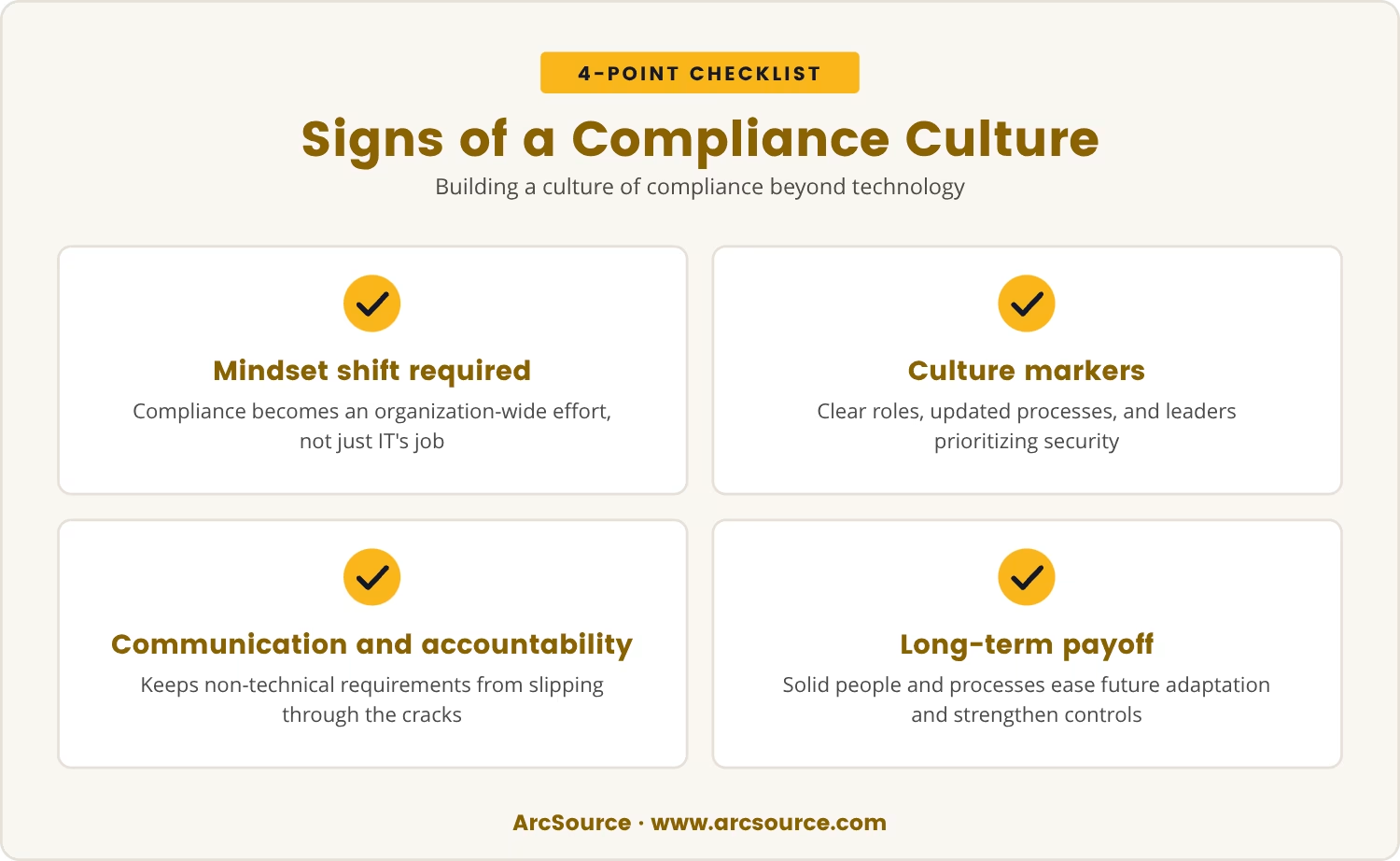
None of this calls for an overhaul; a handful of consistent habits closes most of the gap.
Technology alone leaves a business exposed to findings that better process and stronger staff involvement would have prevented. That's the pattern behind the organizations that treat CMMC level 2 compliance as a continuous practice rather than a box checked once and forgotten.
Addressing people and process risk directly cuts down on surprises when assessment day arrives, and it builds a foundation sturdy enough to carry forward as requirements evolve. In practical terms, that foundation is what protects both the contracts on the table and the reputation behind them in the defense industrial base.

Many organizations with 25 to 75 users have the technical controls in place but still worry about process gaps or staff awareness. At ArcSource, we know that real compliance means more than just technology.
If you want to see how we approach people and process risks, or talk through your own setup, we’re ready to help you strengthen every part of your compliance program.
You can get up to $500,000 in cyber protection included when you work with us—an extra layer of security for your business as you close people and process gaps.
CMMC level 1 covers basic cybersecurity practices meant to protect federal contract information, while level 2 builds in more advanced requirements for handling controlled unclassified information. Level 2 carries forward every level 1 control and adds further process and documentation steps on top.
An incident response plan should be reviewed and tested at least once a year, or sooner if the systems or team behind it change significantly. Regular testing confirms that everyone still knows their role and surfaces gaps before a real incident does.
Most organizations pursuing CMMC level 2 certification need a third-party assessment. That process verifies both the technical and non-technical requirements, including documented procedures and staff training records.
Auditors expect written policies and procedures alongside evidence that they're actually followed, including training records, access review logs, and incident response plans. That documentation needs to stay current and be easy to produce on request during an assessment.
Consistent training, clearly written procedures, and regular communication give staff both the knowledge and the reminder they need to follow cybersecurity practices. Pairing that with assigned accountability and periodic compliance reviews keeps the habit from fading over time.

Dave Monk is the Founder, CEO, and Principal Consultant at ArcSource, bringing a unique background in architecture, engineering, and technology to help businesses solve IT challenges and plan for the future. A UC Berkeley graduate with master’s degrees in Architecture and Structural Engineering, Dave specializes in IT strategy, networks, cloud technology, and business technology solutions.