Cyber insurance is not just about filling out a form—it’s about maintaining the security practices you promised every day. If your real-world actions don’t match your application, your coverage may not hold up when you need it.
Picture this: a 50-person company renews its cyber insurance policy every year without a second thought, confident the paperwork alone keeps it protected. Then a breach hits, and the claim gets denied.
The reason is rarely the policy itself. It's the gap between what the application promised and what the business actually did day to day. That gap is where coverage quietly disappears, and it costs far more than the premium ever did.
The stakes behind this are real: 88% of small business owners say they feel vulnerable to a cyberattack, which shows how much is riding on getting the fine print right.
Understanding how cyber insurance requirements actually work—less like a checklist, more like an ongoing audit—can mean the difference between a claim that pays out and one that doesn't.

Signing a policy and filing it away feels like the end of the task, but that's exactly where the trouble starts. Insurance providers expect the security controls listed on the application to hold up every day, not just on the day it was signed.
So if those practices slip, even briefly, coverage can slip with them. A business that claimed regular security training, then quietly let it lapse, may find its insurer pointing to that gap the moment a breach forces a claim.
The stakes are sharper still for businesses in the San Francisco Bay Area, where change moves fast and cyber threats keep pace with it. Staying consistent with stated practices there is not just a compliance box to check—it's protection against a costly surprise arriving later.
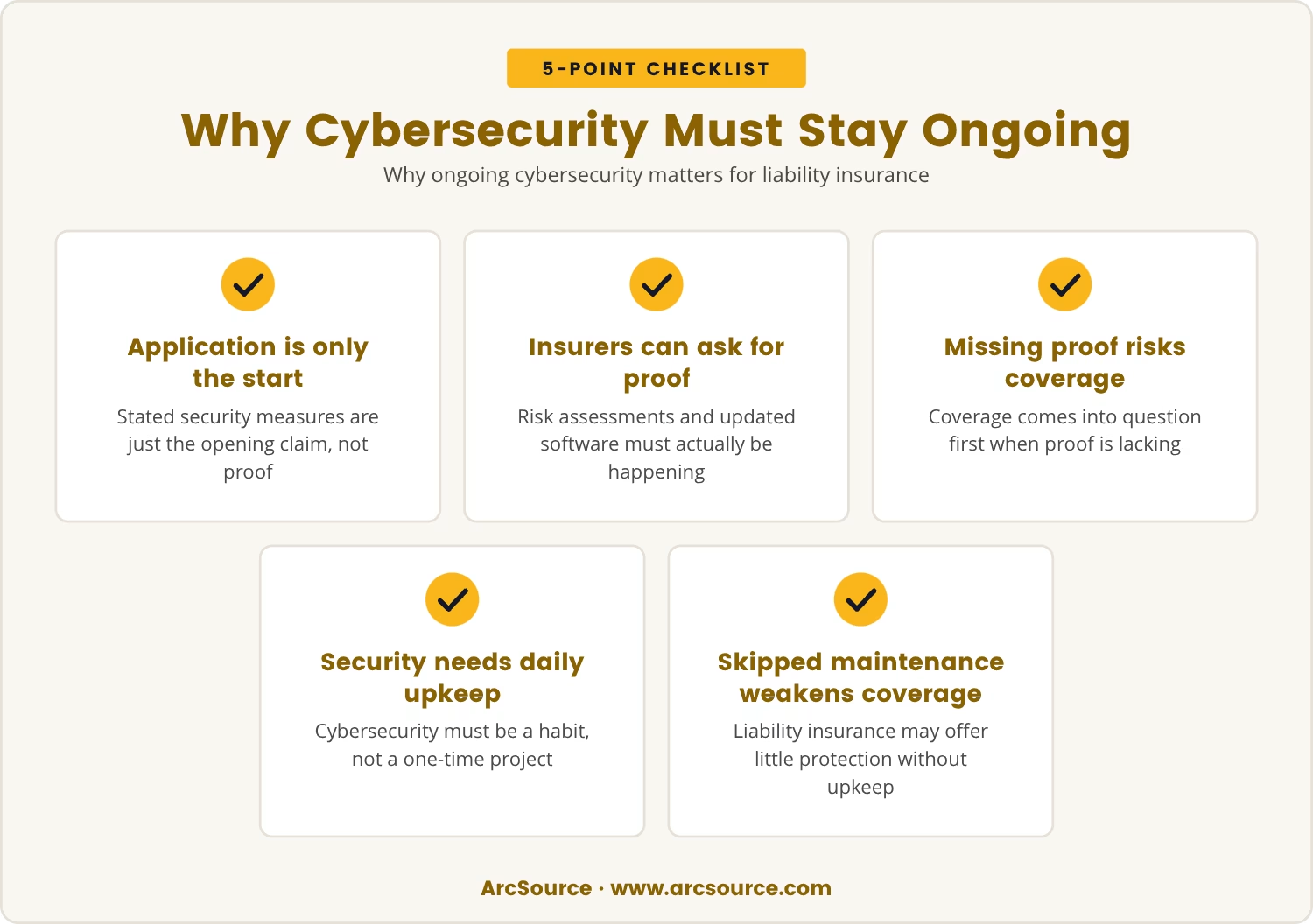
That same consistency is what liability insurance is actually built on: trust. An application states what security measures are in place, but that statement is only the opening line, not the whole story.
Insurers can follow up at any point after that, asking for proof that stated policies are being lived out—risk assessments run on schedule, software kept current. When that proof isn't there, coverage is the first thing to come into question.
Because that scrutiny never really stops, cybersecurity can't be treated as a project with an end date. It has to work as a daily habit, maintained and tested and adjusted as new threats appear. Skip that maintenance, and liability insurance may offer little protection when an actual attack lands.
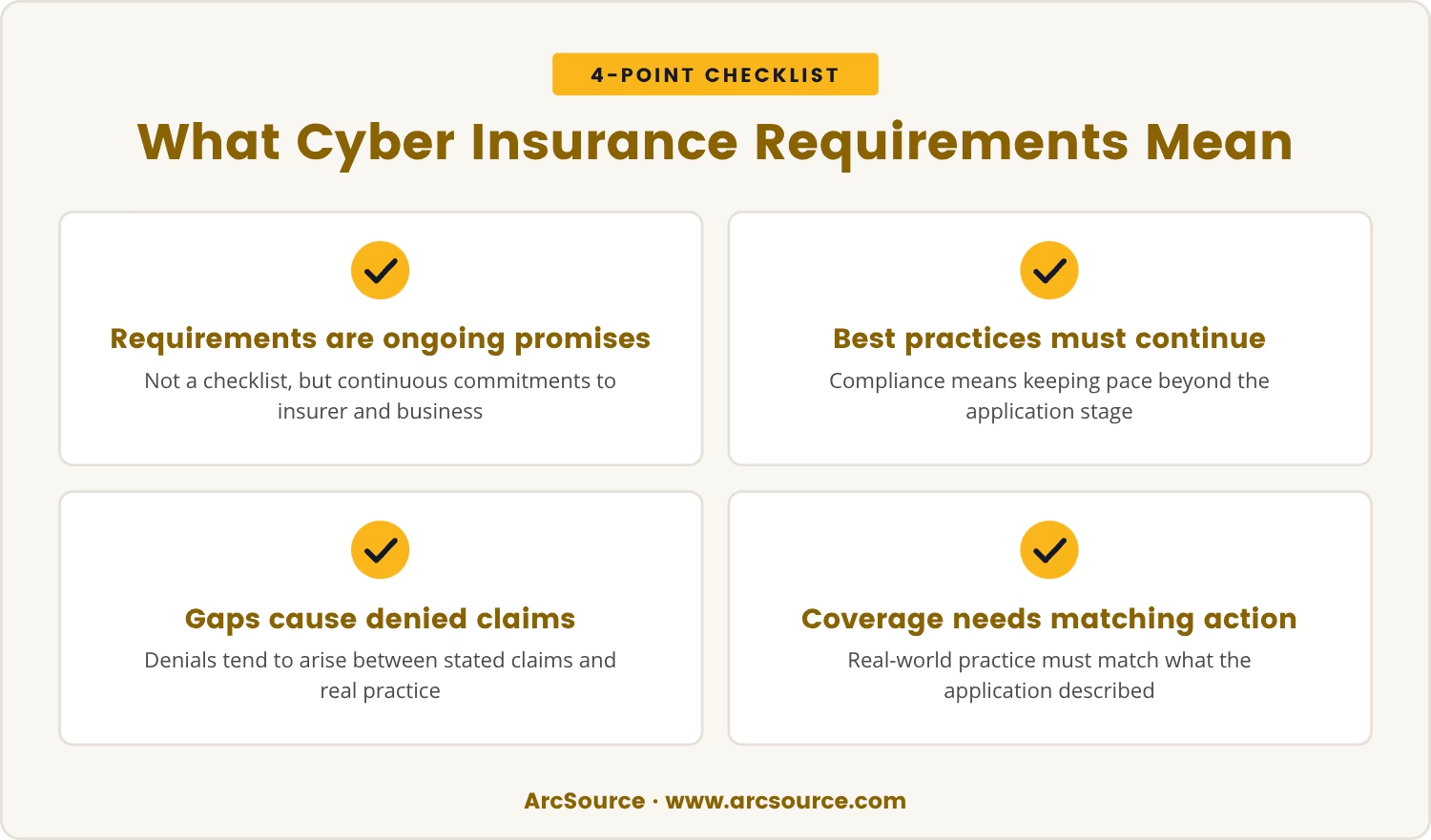
That daily habit is really the substance behind cyber insurance requirements, which amount to less of a checklist and more a set of ongoing promises—to the insurer, and just as much to the business itself. Meeting them means keeping pace with best practices continuously, not only at application time.
Consider a San Francisco business that lists an incident response plan on its application: that plan only holds up if it's kept current and the team actually knows how to run it. The same goes for multi-factor authentication—claiming it means keeping it active for every user, without exception.
It's in the space between the claim and the practice that denied claims tend to originate. Coverage holds only where real-world action matches what the application described, which is exactly why these requirements deserve ongoing attention rather than a one-time signature.
Even businesses that take this seriously tend to lose ground in a handful of recurring spots. The sections below outline where those gaps most often appear.
Insurers expect security controls to keep pace with new threats, not sit frozen at the application date. That means patching software, updating firewalls, and reviewing access management on a regular basis.
Training requirements are often written into the policy itself, not left optional. Skipped sessions or a lapsed schedule can put a business outside its policy's terms.
A written plan is only half the requirement; insurers also expect to see it tested and revised as new threats emerge. A plan that hasn't been exercised is, in practice, no different from no plan at all.
Controlling who can reach sensitive data is its own ongoing task, not a one-time setup. Insurers may ask for logs or evidence that permissions get reviewed regularly.
Every other requirement depends on being able to prove it happened. Insurers may request records of training, updates, and assessments to verify that stated practices match actual ones.
Closing the gap between what the application says and what happens day to day takes deliberate planning, not good intentions alone. A few concrete steps make that planning workable:
Skip those steps, though, and the drift between promise and practice starts costing more than just a denied claim. Premiums can climb, coverage can be dropped outright, and a cyberattack can leave a business paying out of pocket for costs insurance would otherwise have absorbed.
Left unchecked, that drift only widens with time, which is why treating a policy as a one-time task eventually catches up with a business. Regularly checking compliance is what keeps coverage genuinely valid, and for businesses with 25 to 75 users, that habit can be the difference between a fast recovery and a setback that lingers for months.
Avoiding that drift starts with a mental shift: treating cyber insurance as an ongoing audit rather than a hurdle cleared once. That reframing builds daily habits instead of a single compliance event, and it surfaces gaps while they're still small enough to fix.
Making cybersecurity a routine part of operations also builds something harder to quantify: trust with the insurer, the kind that matters most the moment a claim actually gets filed. The goal isn't just meeting requirements on paper—it's making sure the business is genuinely protected underneath them.

For businesses with 25 to 75 users, keeping up with daily security practices can feel overwhelming, especially when insurance requirements keep changing. At ArcSource, we understand how easy it is for real-world habits to drift from what your policy expects.
We invite you to see how our team helps businesses stay aligned with their cyber insurance commitments—so your coverage is there when you need it.
Get up to $500,000 in cyber protection included when you qualify—an added layer of security that supports your ongoing efforts to meet insurance requirements.
If a business stops following the security controls or practices listed on its application, the insurer may deny a claim when a cyber incident occurs. Insurers can review actions taken after a breach and compare them against the original application. Staying consistent with those original commitments is what keeps coverage valid.
Reviewing cybersecurity posture at least once a quarter is a reasonable baseline, though more frequent checks catch problems sooner. Regular reviews surface gaps or lapses before they put coverage at risk. Keeping clear records of each review also helps if the insurer later asks for proof of compliance.
Yes, many cyber liability insurance policies include coverage for losses caused by ransomware attacks. That coverage applies only when the security practices required by the policy have actually been followed. Falling behind on those requirements can put a claim at risk of denial.
Keep records of employee cybersecurity training, software updates, risk assessments, and incident response plan tests. These documents demonstrate that a policy's requirements are being met and can prove essential when a claim needs to be filed.
The right cyber insurance should match a business's risk level, size, and the types of data it handles. For businesses with 25 to 75 users, policies that require practical, ongoing security measures tend to serve better than ones built around a one-time checklist. Consulting a knowledgeable provider can help in choosing coverage that actually fits.

Dave Monk is the Founder, CEO, and Principal Consultant at ArcSource, bringing a unique background in architecture, engineering, and technology to help businesses solve IT challenges and plan for the future. A UC Berkeley graduate with master’s degrees in Architecture and Structural Engineering, Dave specializes in IT strategy, networks, cloud technology, and business technology solutions.